Hurtigruten, Local Ferries and Express Boats: Understanding the Difference
Many visitors planning a trip to Norway assume 'the Norwegian ferry' is the famous Hurtigruten coastal voyage. In reality, for a road trip, you will almost exclusively use local county car ferries, which are an entirely different system. The Coastal Express, operated jointly by Hurtigruten and Havila, is a multi-day voyage between Bergen and Kirkenes. In contrast, a local car ferry is a short crossing, often just minutes long, that functions as a floating bridge on the public road network. A third option, the hurtigbåt or express boat, is a fast catamaran for foot passengers only.
A common misconception is that you can tour Norway by driving your car on and off the Hurtigruten or Havila ship each day. This is not possible. Bringing a car on board is a niche, port-to-port transport service that must be arranged in advance. It is not designed for a hop-on, hop-off road trip. For almost every fjord crossing or coastal connection on a driving holiday, you will be using a local, unbookable car ferry, not the Coastal Express.
The Coastal Express: Hurtigruten and Havila
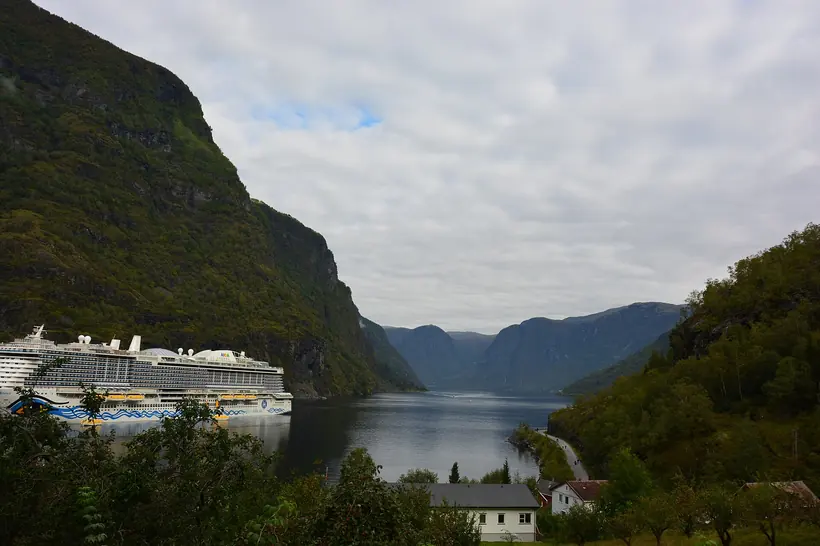
The Norwegian Coastal Express, or Kystruten, is a single, continuous route between Bergen in the south and Kirkenes in the Arctic north. Since 2021, this route has been operated by two companies: Hurtigruten, which runs 7 ships, and Havila, which runs 4. They are not rivals on different routes; they are partners on the same one, sharing the same timetable with 11 ships providing alternating daily departures from all 34 ports.
This service is a working transport line that has carried local passengers, mail, and cargo since 1893, not just a tourist cruise. The full one-way journey takes about 7 days, and a round trip is roughly 12-13 days. Any overnight travel requires booking and paying for a cabin. Due to its popularity, especially in summer, booking well in advance is key.
Bringing a Car on the Coastal Express
Taking a car on the Coastal Express is a limited service for moving a vehicle between two specific ports, not for touring. You must arrange this directly with the operator's customer service ahead of time.
- Hurtigruten: Only some ships have a car deck, with space for roughly 20-30 cars. The ships MS Trollfjord, MS Finnmarken and MS Midnatsol do not carry cars at all. Caravans and trailers are not permitted.
- Havila: Havila's four RoPax vessels can carry about 9 cars each. Vehicle transport must be booked in advance. Critically for those with rental cars, electric, hybrid, and hydrogen vehicles are banned from Havila ships for fire-safety reasons.
On both lines, cargo takes priority over private cars. Drivers must be ready for boarding well before departure: by 18:00 in Bergen, one hour before sailing in Trondheim, Bodø, Tromsø and Kirkenes, and 30 minutes before at other ports. Cars cannot be loaded or unloaded at ports served only by tender boats, such as in the Geirangerfjord or Hjørundfjord.
Local Car Ferries: The Backbone of a Road Trip
When you see a 'ferry' sign on a Norwegian road, it refers to a local car ferry that acts as part of the highway. These are practical, short crossings, usually lasting from a few minutes to about an hour. You simply drive on, wait for the crossing, and drive off. There are no cabins or cruise-like facilities.
How Payment and Booking Work
For the vast majority of these ferries, there is no advance booking; they operate on a first-come, first-served basis. There is also no ticket booth for cars. Payment is handled automatically through the AutoPASS system. Cameras scan your vehicle's number plate, and the toll is charged to the registered vehicle owner. If you have an AutoPASS account, you receive a discount. For rental cars, the hire company will pass the ferry charges on to you.
Travel for Foot Passengers and Cyclists
On public-road car ferries, travel is free for foot passengers and cyclists. You can simply walk or cycle on board without a ticket. This makes these ferries an excellent way to explore coastal areas without a car.
Hurtigbåt: The Fast Express Boats
A hurtigbåt is a fast, passenger-only catamaran, also known as an express boat. These vessels connect islands and coastal communities, providing a important link for local residents. They do not carry cars. Express boats are faster than the car ferries but often take a more direct, less scenic route. The ride can also be rougher in open water. Tickets are sold per person for specific journeys.
Which Service Do You Need? A Comparison
Choosing the right vessel depends entirely on your travel plans. The table below clarifies the main uses for each type.
| Feature | Hurtigruten/Havila Coastal Express | Local Car Ferry | Hurtigbåt (Express Boat) |
|---|---|---|---|
| Primary Use | Multi-day coastal voyage (Bergen-Kirkenes), point-to-point passenger/cargo transport. | Short vehicle and passenger crossing, part of the road network. | Fast passenger transport between coastal towns and islands. |
| Carries Cars? | Yes, limited and must be pre-booked as port-to-port transport. Not for touring. | Yes, this is its main purpose. | No, passengers only. |
| Booking | Must be booked in advance, especially for cabins and vehicles. | No booking needed for most routes. First come, first served. | Tickets are required for each passenger per journey. |
| Duration | 7 days one-way (full route). Port-to-port legs vary. | Minutes to about an hour. | Varies, but generally the fastest sea route. |
| Frequency | Once per day in each direction from each port. | Frequent, often multiple departures per hour. | Scheduled departures, typically a few times per day. |
| Cost | Relatively expensive; overnight trips require a paid cabin. | Charged per vehicle via AutoPASS. Free for foot passengers/cyclists. | Ticketed per person. |
In summary, if you are undertaking a classic multi-day coastal voyage from Bergen to Kirkenes, you need the Hurtigruten or Havila Coastal Express. If you are on a road trip and need to cross a fjord, you will use a local car ferry. And if you are travelling without a car and need to get between coastal towns quickly, the hurtigbåt is your service.